
Therapy for Relationship OCD (ROCD) in Baltimore, MD
Feel confident in your relationship and overcome intrusive thoughts, anxiety, and doubt with evidence-based therapy.
Signs you might be dealing with ROCD
A little uncertainty is completely normal in any relationship. Persistent intrusive thoughts, distress, and rumination are not. ROCD is like any other form of OCD: the doubt doesn't go away, no matter how much reassurance you get.
Constant reassurance-seeking
Repeatedly asking your partner or yourself if the relationship is right.
Doubting your own feelings
Questioning whether you truly love your partner, ruminating about your compatibility, and wondering if you're settling.
Comparing and checking
Comparing your relationship to others and overanalyzing your own feelings, even during intimacy.
Avoiding closeness or commitment
Pulling back from intimacy, or freezing up on big decisions like moving in or getting married.
A common pattern in ROCD is the urge to confess every doubt to your partner, hoping it'll finally bring you certainty. It's exhausting and really a compulsive OCD behavior, which is why it doesn't work the way it feels like it should. If this sounds familiar, our post on why compulsive confession keeps ROCD going gets into why the relief never lasts, and what to do instead.
If you're further along and looking for concrete strategies to interrupt the doubt cycle on your own, how to stop ROCD thoughts walks through the same tools we use in session.
Evidence-based, flexible treatment
Our collaborative and flexible approach to treatment makes sure you receive the best research backed therapy for ROCD.
Cognitive Behavioral Therapy
Helps you catch the specific doubts driving your anxiety, and test them against what's actually true instead of what OCD is telling you.
Exposure & Response Prevention
The most well-researched OCD treatment there is. You practice sitting with relationship uncertainty on purpose, without checking or seeking reassurance.
Acceptance & Commitment Therapy
Builds tolerance for uncertainty itself, so doubt no longer has to be resolved before you can feel present in the relationship.
Inference-Based CBT
Targets the reasoning errors ROCD relies on, like the mental leap from "I had a thought" to "something must be wrong."
Effective ROCD Therapy
"If you or someone you care about is struggling with OCD or anxiety, you won't find a more dedicated, compassionate, and skilled professional... His use of CBT and ERP is both effective and empowering, helping clients break free from the cycles of intrusive thoughts and compulsions that can feel overwhelming."
Avi F. — Pikesville, MD
"I came to him with issues related to OCD and anxiety... very understanding and helped me work through some very distressing thought patterns. Sharing was very easy and I never felt any type of judgement or shame."
Michael D. — Catonsville, MD
"I experienced an episode... completely took over my life... Over the course of a year working with Yisrael, I learned to understand and identify my anxious thoughts. Now I feel equipped with the knowledge and skills to manage my anxieties as they arise."
Kevin D. — Fells Point, Baltimore
Common questions about ROCD therapy
Is ROCD a real, diagnosable condition?
Not as its own diagnosis, no. ROCD is a subtype of OCD, and we treat it the same way, with evidence-based approaches like ERP. It can feel unique to your relationship, but it's a well-understood, treatable pattern.
How is ROCD different from normal relationship doubt?
Everyone has doubts about their relationship sometimes. ROCD doubt is different: it doesn't let up, and reassurance only helps for a few minutes before it comes back, often stronger. That pattern is usually the giveaway, more than the doubt itself.
How long does ROCD therapy typically take?
It varies by person, but many clients notice meaningful change within 8–16 weekly sessions using ERP. We'll build a plan around your specific triggers rather than a fixed timeline.
Do you offer virtual sessions, or only in-person?
Both. We see clients in person at our Mount Washington, Baltimore office, and via secure teletherapy anywhere in Maryland. Many of our current clients choose virtual sessions after the first appointment.
Do you accept insurance?
We're private-pay and out-of-network. That's what lets us keep caseloads small and stay responsive to the people we're working with. Many clients use their out-of-network benefits to offset the cost, and we'll help you check yours.
Straightforward, private-pay pricing
- Standard session (45 min) $225
- Initial appointment (60 min) $300
Many clients use out-of-network insurance benefits to offset the cost. We'll help you check yours before you commit to anything.
In-person, virtual, and hybrid
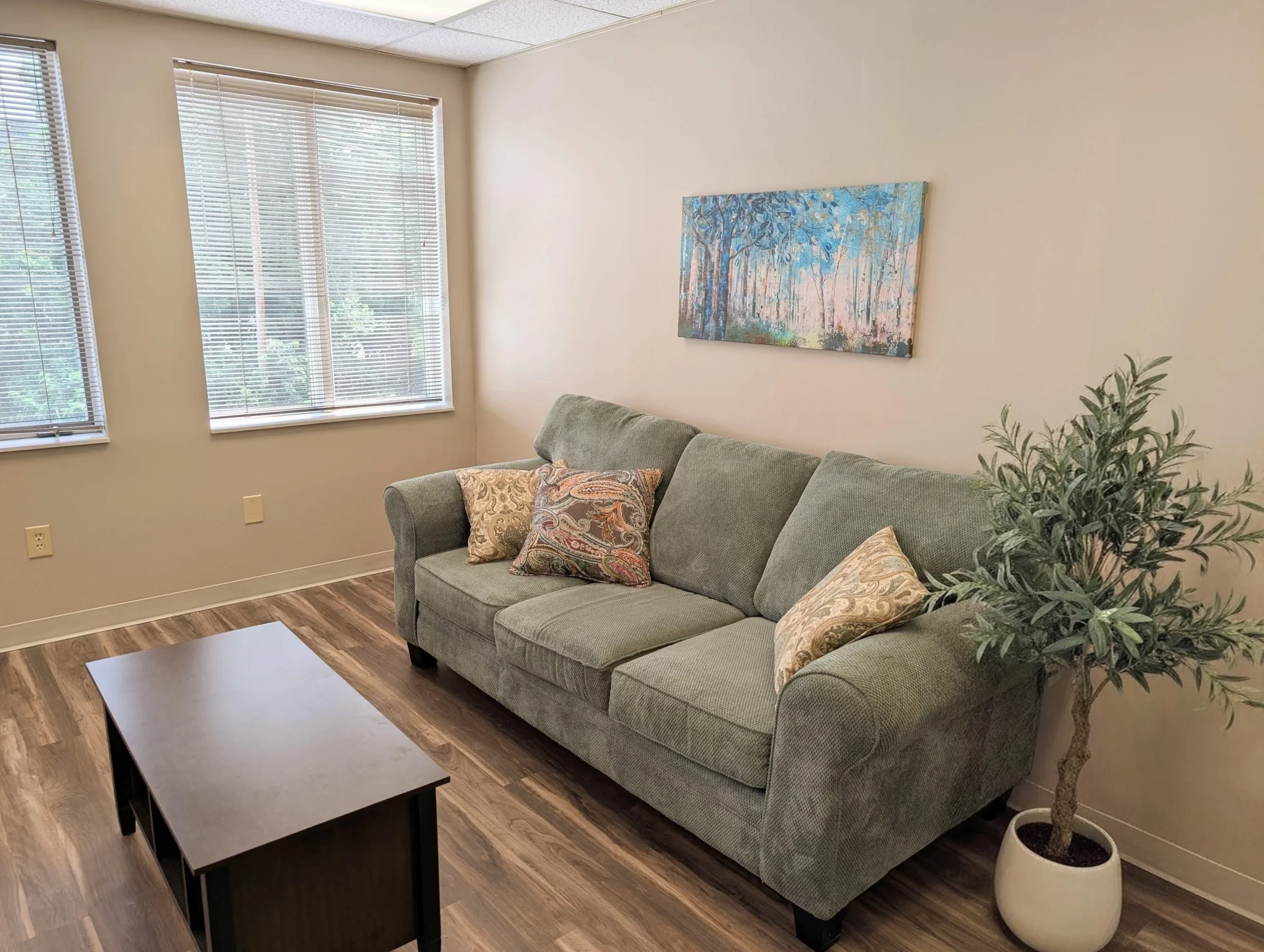
In-person Baltimore office
Our in-person office is located in the Mount Washington neighborhood at 1501 Sulgrave Ave., Suite 206, Baltimore, MD 21209. A convenient and quick drive from most areas in Baltimore City and County.
(443) 296-2584
Virtual and hybrid therapy
We offer secure teletherapy anywhere in Maryland. Most current clients choose virtual sessions for the flexibility.
Get started with therapy for relationship OCD
Choose a convenient time for your consultation with a relationship OCD specialist. Book a free 15-minute consultation to talk through what you're experiencing and whether ROCD therapy is the right fit.